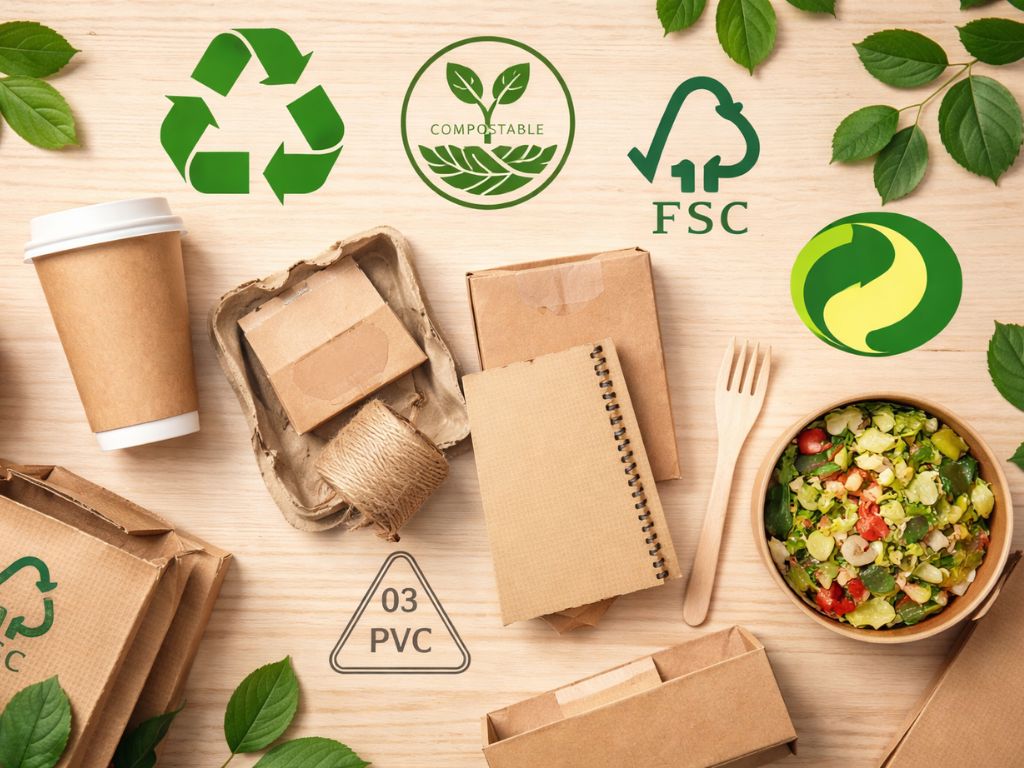
Take a closer look at almost any package today and you’ll notice it’s covered with symbols — arrows, logos, icons, and certifications. Packaging symbols play a critical role in how products are disposed of, how businesses comply with regulations, and how consumers judge a brand’s credibility.
Understanding packaging symbols is no longer optional. For businesses operating in the EU, these marks influence compliance, recyclability, and consumer trust, while for consumers, they provide guidance on how to sort waste correctly and make more responsible choices.
This article breaks down the most common packaging symbols you’ll encounter today, what they mean, and why they matter.
Packaging symbols serve three main purposes:
Education – helping consumers understand how to dispose of packaging correctly
Compliance – ensuring businesses meet legal and regulatory obligations
Transparency – building trust by clearly communicating material choices and sustainability claims
The Möbius loop — the well-known triangle of chasing arrows — is one of the most widely recognised recycling symbols worldwide. It indicates that a product or packaging can be recycled, or that it contains recycled content (sometimes shown with a percentage inside the symbol).
However, it’s important to note:
The symbol does not guarantee the packaging will be recycled everywhere
Recycling depends on local collection and processing systems
Often found inside the Möbius loop on plastic packaging, resin codes (numbers 1–7) identify the type of plastic used, such as PET, HDPE, or PP. These codes help waste processors sort materials more efficiently but are often misunderstood by consumers as a guarantee of recyclability — which is not always the case.
As compostable packaging becomes more common, so do labels claiming “biodegradable” or “compostable.” These terms are not interchangeable and must be used carefully.
Compostable symbols (often linked to EN 13432 certification) indicate that packaging can break down under specific composting conditions, usually industrial composting.
Biodegradable claims simply mean a material can break down over time — but without clear timelines or conditions, the term can be misleading.
Clear certification marks help prevent greenwashing and guide consumers to dispose of packaging correctly, rather than placing compostable items in recycling streams where they don’t belong.
The Triman logo is a mandatory sorting symbol in France for many household packaging items. It indicates that the product must be sorted and recycled and is often accompanied by detailed sorting instructions.
For businesses selling packaging or packaged products in France, Triman compliance is essential. The logo plays a key role in helping consumers understand disposal rules, especially as France continues to tighten regulations around waste sorting and recyclability.
The Green Dot symbol is often misunderstood. It does not mean that packaging is recyclable. Instead, it indicates that the producer has contributed financially to a packaging recovery scheme in certain European countries.
While the Green Dot is still relevant in some markets, its presence alone should never be used as a sustainability claim. For businesses, understanding the distinction is crucial to avoid misleading consumers.
For paper and cardboard packaging, FSC (Forest Stewardship Council) and PEFC (Programme for the Endorsement of Forest Certification) logos indicate that the materials come from responsibly managed forests.
These certifications:
Support sustainable forestry
Enhance brand credibility
Are widely recognised by consumers and retailers
For businesses using paper packaging, FSC or PEFC certification is often a strong signal of environmental responsibility — especially in the food, retail, and pharmaceutical sectors.
As EU packaging regulations continue to evolve, packaging symbols are becoming more standardised, more scrutinised, and more influential. Businesses that take the time to understand and apply them correctly are better positioned to meet regulatory requirements, support recycling systems, and build long-term trust with their customers.
Packaging symbols may be small, but their impact is anything but.
Racontez-nous votre développement, on s'occupe du packaging.
Parler à l'équipe